
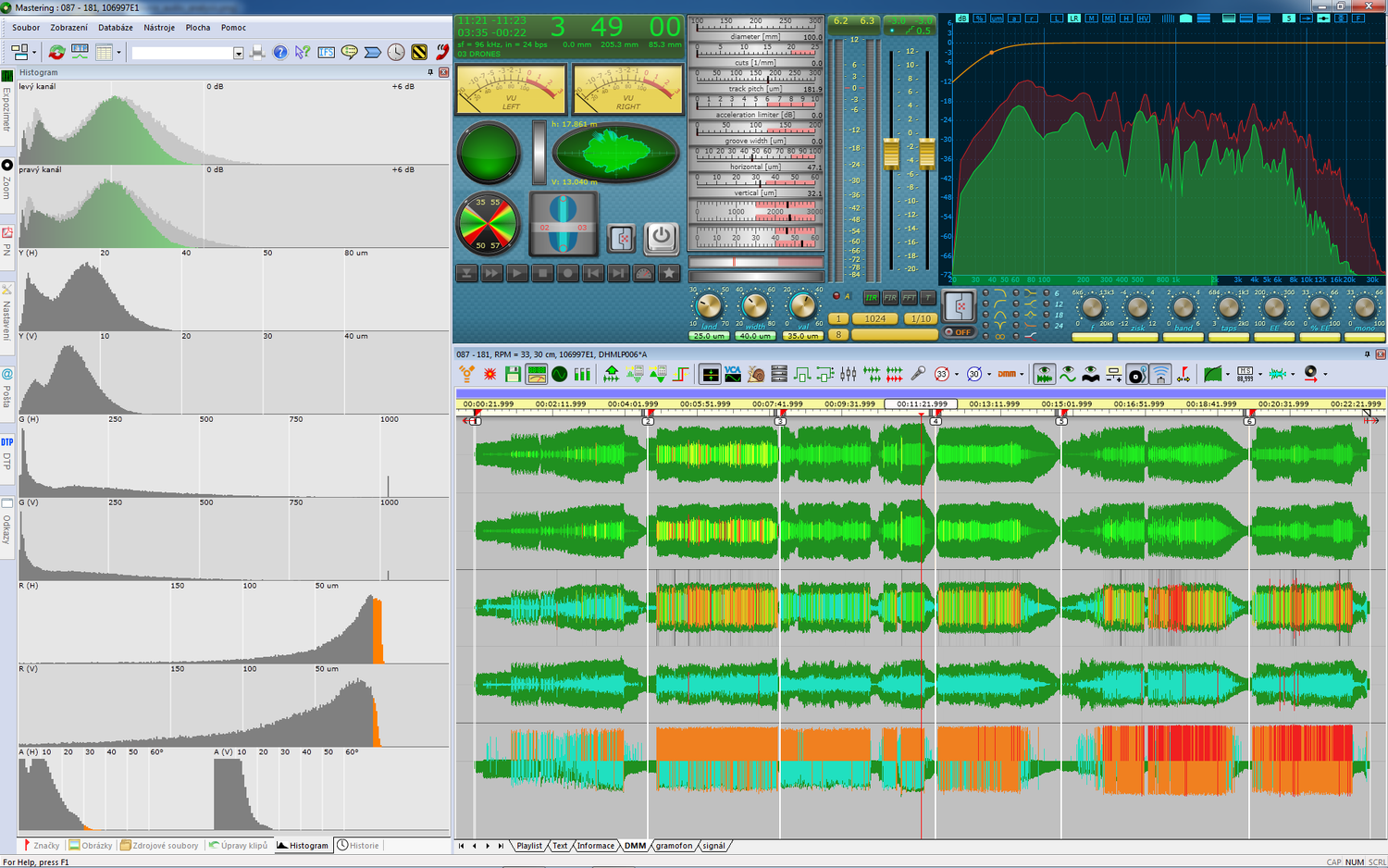
VINYL VISUAL MASTERING
Vinyl Visual Mastering is an integrated system intended for the first part of vinyl manufacturing. It includes both the specialized audio mastering process for the vinyl medium and the cutting of the master using a DMM or a lacquer cutter.
It is developed by a team of engineers and qualified technicians with many years of experience in physics, electronics, computer programming, and vinyl manufacturing technologies.
The VVM system was built around the towers of Neumann engravers. Their basic functionalities have been extended by new capabilities and some original parts have been completely replaced by new software algorithms.
The entire engraving process is controlled by a computer, all important values and the state of the engraver are displayed on a graphical user interface and recorded for later inspection, so the engineer can focus on the music.
BASIC PRINCIPLE
The basic principle can be compared to the difference between film and digital photography.
Before pressing the shutter of a camera, you usually have to adjust various opposing settings (aperture, shutter speed, sensitivity, focus, etc.). If these are set correctly, the result is a beautiful sharp image. Incorrect settings result in blurry, dark, or overexposed photos.
In the case of film photography, the result of the process is only known for sure after the film is developed and the prints are made. The electronics of a digital camera can evaluate a scene based on a given parameter and display the result on the screen. Before pressing the shutter, the camera warns us that the result will probably not be good.
The new vinyl mastering system is based on a similar principle. Before starting the mastering, a computer application analyzes the audio data and models a virtual groove on the computer. It is thus possible to know in advance the required space and all the critical passages that cannot be recorded or played back later without distinct distortion. The computer application also allows adapting the original signal to remove only the unwanted elements causing the distortion.
PREMASTERING AND SEPARATE BURNING
In the studio, our premastering specialists will carefully check and analyze the provided audio files, perform multiple burning simulations, and determine the optimal settings for each side, without critical sound modification. Our goal is to use only the necessary corrections (volume adjustments, linear phase EQ, compressors, limiters, mono EE filters, etc.) that will help minimize the risk of distortion and allow the best frequency response across the widest range of audible frequencies.
We use a groove processor with our engravers: a new pitch control software that can efficiently save space during engraving and is more effective than any other system in the world. It allows our technicians to engrave longer recordings without reducing the engraving volume.
The new system offers other advantages such as increased control over the quality of the entire engraving process, a faster working method, and the storage of engraving parameters in a database. This type of engraving is an easily reproducible process in case of damage to the matrices during later production stages, or in case of reissues for which a perfect replica is necessary.
We can also directly compare the audio signals recorded from the mother matrix feedback or a test pressing with the audio source, visually and by ear, and thus proceed with an in-depth analysis.
MAIN FEATURES
- Direct two-way communication between the computer and the cutter.
- High-quality non-destructive signal processing with unique vinyl algorithms. The original audio data remains intact for future use.
- Individual mixing parameters that can be adjusted for specific parts of the audio.
- System of geometric, physical, dynamic, and load measurements (duration and frequencies).
- Highly accurate virtual cutting simulator detecting critical parts in the provided audio before the actual cutting.
- Groove Processor – control of track pitch, groove width, and adaptation of audio signals to compensate for possible distortion related to cutting and playback.
- Differential sound and graphical analysis to detect differences between the original audio and the processed signal, the feedback, or the pressed vinyl record signal.
- Mathematical modeling of the stylus and groove – the software calculates a virtual groove based on the geometric dimensions of a given cutting stylus and allows visual comparison with a real photo of the groove taken under a microscope.
PATH OF THE SIGNAL
1. Digital source
The new mastering system is capable of working with the most common digital audio formats (WAV, AIFF, FLAC, APE, DDP, CD-Audio discs, CUE/BIN images, etc.) and can use high-resolution audio files with sample rates up to 192 kHz and up to 32-bit resolution.
All necessary audio processing is performed by the Vinyl Visual Mastering software.
No external box, plug-in filter, delay line, or sample rate converter is used.
Only a single stereo signal is transmitted to our cutters. No direct audio signal is needed to control the track pitch or groove width.
2. Analog source
We use a Telefunken M15A tape player following the original method of processing the signal entirely analog, without delay lines or AD/DA converters.
It is possible to combine both methods, namely digitizing the tape in advance, running a simulation in our mastering software, determining the optimal settings, and then setting the parameters on our Neumann analog mastering console prior to cutting.


