
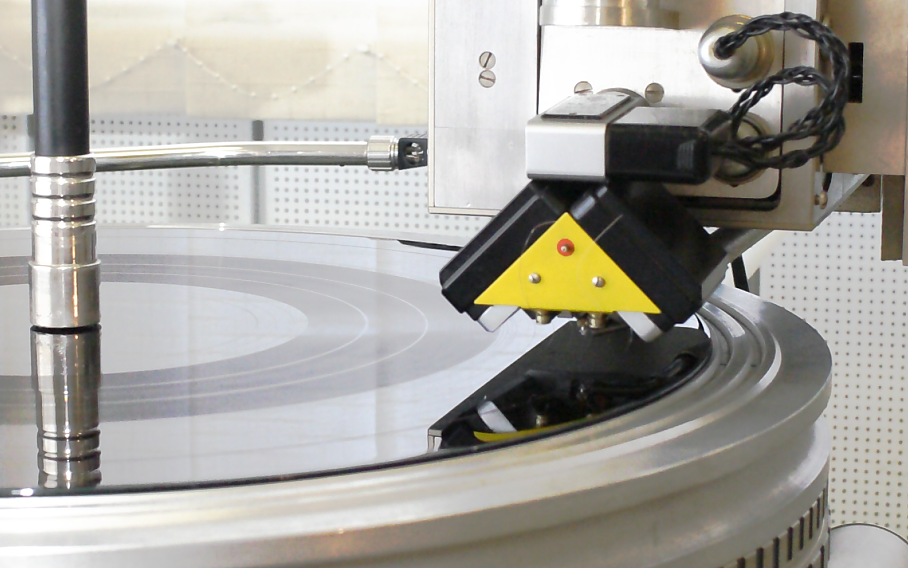
ENGRAVING ON LACQUERS
Lacquer cutting is an older mastering method, but it still has many supporters.
This analog mastering technique is still widely accepted and used due to the large number of cutters manufactured and kept by studios over the years.
GZ owns and still uses several VMS-70s, one of the most reliable models ever made. Our engineers and technicians have also improved the technology in 2011, so it can now fully benefit from the advantages of the new Vinyl Visual Mastering system, like the DMM models.
PRINCIPLES OF LACQUER ENGRAVING
The audio signal is transcribed onto a master disc, called a lacquer, via a dedicated cutting head. This head consists of two mobile coils perpendicular to each other: one for the left channel and one for the right channel. The movements of the two coils are transferred to a stylus with a triangular tip at its end. The stylus, made from precious stones (sapphire or ruby), is heated to engrave the soft material that makes up the lacquer. It cuts a V-shaped sound groove directly into the nitrocellulose layer covering an aluminum plate.
The matrices for pressing records are made from these "mother" lacquers through a three-step electroforming (galvanization) process in electrolytic baths. It is recommended to start this galvanic step with lacquers that have been etched for 48 to 72 hours, in order to avoid groove deformations caused by heat and other environmental factors.
ADVANTAGES OF ENGRAVING ON LACQUERS
The lacquer layer is softer and thicker than the copper used in DMM, allowing:
- Greater vertical amplitudes that can carry more out-of-phase low-frequency signals (for example, a bass guitar or a kick drum placed in a single channel), but with a higher risk of playback head skipping (groove exit).
- Wider and deeper grooves that better tolerate most types of surface damage and offer slightly higher resistance to skips caused by poorly calibrated turntables. However, wider and deeper grooves can cause more problems during subsequent galvanization and pressing processes, such as higher surface noise (hiss), more crackles and pops.
- Deep cutting levels giving high playback volumes while increasing the risk of various distortions and skips/slips of the playback heads on certain turntables.
Lacquer cutting is better suited for loud and short recordings, especially for records intended to be played in clubs (dance, techno, dub, drum'n'bass, ...) or intended for scratching.


