
ENGRAVING DMM
DMM (Direct Metal Mastering) engraving is an analog mastering technique developed in the 1980s by two German companies, Teldec (Telefunken-Decca) and Georg Neumann GmbH.
At GZ Media, we implemented DMM in 1985 before it soon became the most widely used technology within the group.
The introduction of the new Vinyl Visual Mastering system in 2010 subsequently enabled the advent of a new era of development opportunities and improvements in the DMM mastering process.
PRINCIPLES OF DMM TECHNOLOGY
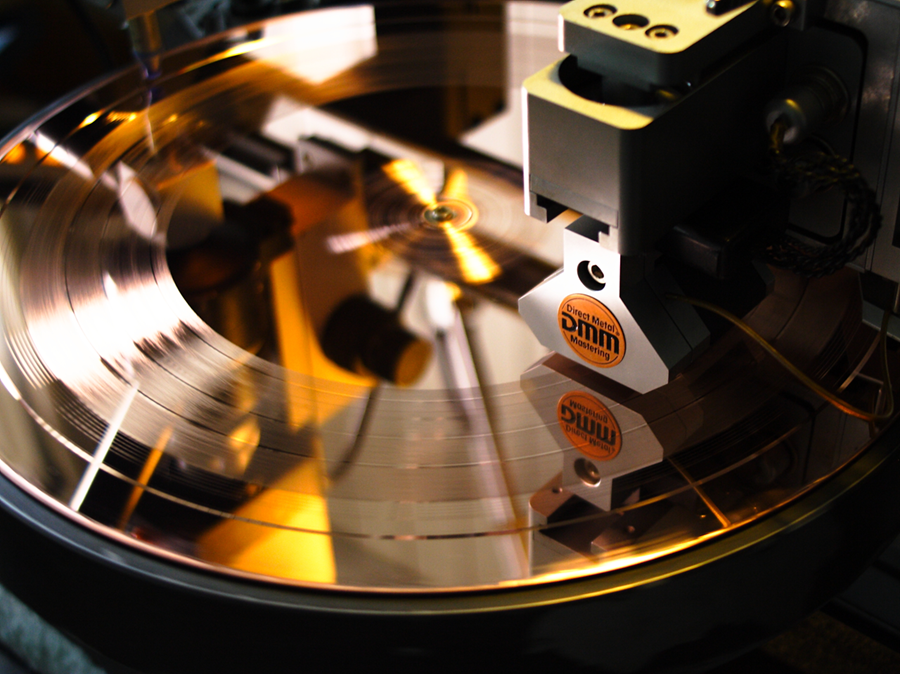
The audio signal from the mastering console - or from a magnetic tape - is transcribed onto a copper master disc via a dedicated DMM cutting head. All modern stereo cutting heads consist of two moving coils perpendicular to each other: one for the left channel and one for the right channel. The movements of the two coils are transferred to a cutting stylus with a triangular tip at its end.
In the case of DMM, this stylus is specially made from ground diamond. It cuts a V-shaped groove directly into a copper layer covering a non-magnetic steel disc. The matrices for pressing discs are made directly from these copper plates through a single-step electroforming process in electrolytic baths.
ADVANTAGES OF DMM TECHNOLOGY
- More accurate reproduction of high frequencies
- Reduction of background noise (better signal-to-noise ratio)
- Reduction of pre-echo from adjacent grooves
- Improved transient peak response
- More efficient use of the total available recording surface: longer playback times
- Only one subsequent electroplating step
- More stampers obtained from the copper master without damaging the master
GZ Media is the only place in the world to operate 4 DMMs for vinyl record production


